Invoice vs Bill: What Is the Difference?
An invoice and a bill are often the same document seen from the seller and the buyer. Here is how the two words differ and when to use each.
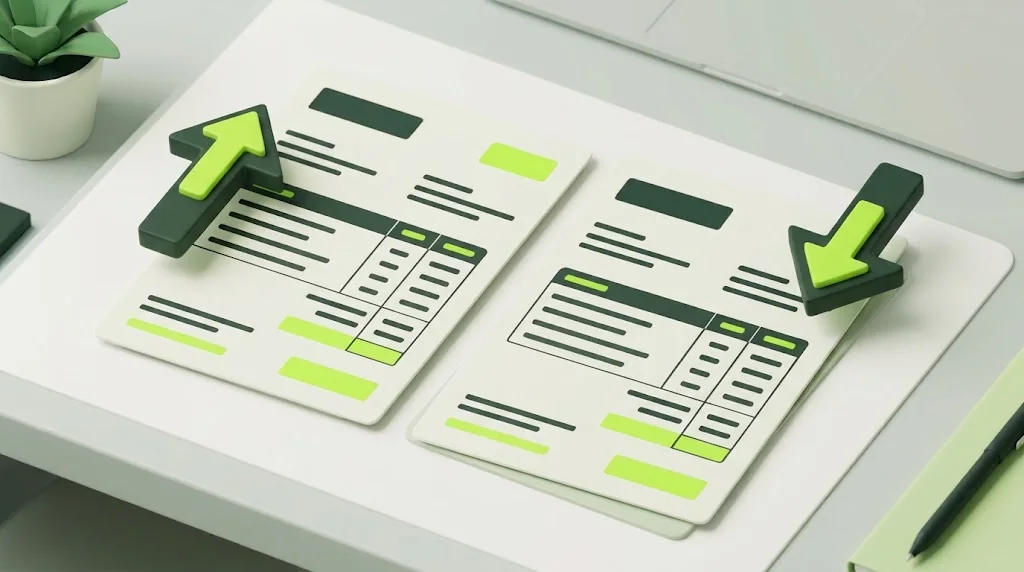
An invoice and a bill are usually the same document seen from two sides. The seller sends an invoice to request payment, and the buyer receives it and records it as a bill to pay. In everyday speech, "bill" is also used for instant charges such as a restaurant bill or a utility bill, while "invoice" is the more formal word used between businesses.
Invoice vs bill: the short answer
If you sell something, you issue an invoice. If you buy something, you receive a bill. The paper or PDF is often identical. What changes is who is looking at it and where it sits in their books.
Accountants use the words this way because it keeps the two sides of a sale separate:
- Invoices you send are money owed to you. They sit in accounts receivable.
- Bills you receive are money you owe. They sit in accounts payable.
Most accounting software follows the same language. You create invoices for customers and enter bills from suppliers.
Key differences at a glance
| Invoice | Bill | |
|---|---|---|
| Point of view | Seller | Buyer |
| Purpose | Request payment for goods or services | Show what you owe and need to pay |
| In the accounts | Accounts receivable (money coming in) | Accounts payable (money going out) |
| Typical setting | Business to business work, freelancers, contractors, wholesale | Utilities, restaurants, phone plans, and supplier invoices you receive |
| Payment timing | Often has terms such as Net 14 or Net 30 | Often due straight away, or by a set date each month |
| Level of detail | Usually detailed: line items, invoice number, payment terms, tax | Can be detailed or very simple, depending on who issues it |
When people say "bill" instead of "invoice"
Outside accounting, the choice of word often comes down to habit and setting. People tend to say "bill" when:
- The charge is for something already used, such as electricity, water or a phone plan.
- Payment is expected on the spot, as with a restaurant or bar bill (often called a "check" in the US).
- It is a household or consumer charge rather than a business transaction.
People tend to say "invoice" when:
- One business is charging another.
- A freelancer or contractor is charging a client for work.
- The document has payment terms, an invoice number and a due date some time after it is issued.
Both are requests for payment. "Invoice" simply sounds more formal and is the standard term in business.
Is an invoice a legal document?
An invoice is a record of a sale and a request for payment. It is not usually a contract on its own, but it is strong evidence of what was agreed and supplied, and tax authorities expect businesses to keep invoices as records. In many countries, including the UK for VAT registered businesses, invoices must include certain details to be valid for tax purposes. You can read more in our guide to VAT invoice requirements in the UK.
Rules differ by country, so check local requirements or ask an accountant if you are unsure what your invoices must show.
What an invoice should include
Whether your client calls it a bill or an invoice, a clear document gets paid faster. A typical invoice includes:
- The word "Invoice" and a unique invoice number.
- Your business name, address and contact details.
- Your client's name and address.
- The invoice date and the due date.
- A list of goods or services with quantities, rates and line totals.
- Subtotal, any tax, discount or shipping, and the total due.
- Payment terms and how to pay.
Here is a simple example layout:
INVOICE No. INV 0108
Invoice date: 3 November 2026
Due date: 17 November 2026 (Net 14)
From: Green Lane Design, 12 High Street, Leeds
To: Harper and Co Ltd, 40 Park Road, York
Logo design, 1 x £600.00 = £600.00
Business card design, 1 x £150.00 = £150.00
Subtotal: £750.00
Total due: £750.00
Pay by bank transfer, quoting INV 0108 as the reference.
When Harper and Co receive this, their bookkeeper enters it as a bill for £750.00 due on 17 November. Same document, two names.
For a full checklist, see what to include on an invoice.
Invoice vs bill vs receipt
It is easy to mix these up, so here is how they fit together:
| Document | When it is used | What it says |
|---|---|---|
| Invoice | Before payment, sent by the seller | Here is what you owe me |
| Bill | Before payment, received by the buyer | Here is what I owe |
| Receipt | After payment | This has been paid |
A receipt is proof that payment was made. Our guide to invoice vs receipt explains the difference in more detail.
How to handle invoices and bills in your own books
Most small businesses deal with both every month. You send invoices to customers and receive bills from suppliers, software providers and utilities. Keeping the two separate makes cash flow far easier to follow.
- Number your own invoices in one sequence. This gives every sale a unique reference. Our guide on how to number invoices shows simple systems that work.
- Record every bill you receive with its due date. Paying suppliers on time protects your relationships and helps you avoid late charges.
- Mark invoices as paid when the money arrives. This tells you exactly who still owes you.
- Keep copies of both. Tax authorities in the US and UK expect you to keep records of sales and expenses for several years. Ask your accountant how long you need to keep them where you are.
Common mix ups to avoid
- Calling a receipt an invoice. If the client has already paid, send a receipt, not an invoice.
- Sending a "bill" with no number or date. A charge without an invoice number and due date is harder for a business client to approve and pay.
- Forgetting the due date. Write an actual date, not just "Net 30", so there is no doubt when payment is expected.
Which word should you use with your clients?
If you are a freelancer, contractor or small business charging for work, use "invoice". It is the standard term, it is what accounts teams expect, and it is what most clients will search for in their inbox.
That said, there is no harm in matching your client's language. If a homeowner asks for "the bill", send your invoice and call it whatever makes them comfortable. What matters is that the document is clear, numbered and shows exactly what is due and when.
How to create an invoice for free
You can make a professional invoice in a few minutes with the free InvoiceGeneratorKit invoice generator. There is no sign up needed. Add your logo, your client's details and your line items, and the totals, tax and discounts are worked out for you. Invoice numbers are added automatically, and you can download a vector PDF ready to send.
If your client needs a different document, you can change the title to Receipt, Quote, Estimate, Proforma Invoice or Tax Invoice. Your invoices are saved privately in your browser, and History shows which ones are paid, unpaid or overdue.
Frequently asked questions
Is an invoice the same as a bill?
Often, yes. The seller calls it an invoice because it requests payment, and the buyer calls it a bill because it is money they owe. The document itself can be identical.
Do I send an invoice or a bill to my client?
If you are charging for goods or services, you send an invoice. Your client will usually record it as a bill in their own accounts.
Where do invoices and bills go in the accounts?
Invoices you send go into accounts receivable, which is money owed to you. Bills you receive go into accounts payable, which is money you owe.
Is a bill the same as a receipt?
No. A bill or invoice asks for payment, while a receipt confirms that payment has been made.
Create your invoice now
Add your logo, line items and tax, see it on a real A4 page, then download a clean PDF. Free, with no sign up.