What to Include on an Invoice: The Complete Checklist
Every invoice needs a few essential details to be valid and to get paid on time. Here is the full checklist, plus the extra rules for VAT invoices, sole traders and limited companies.
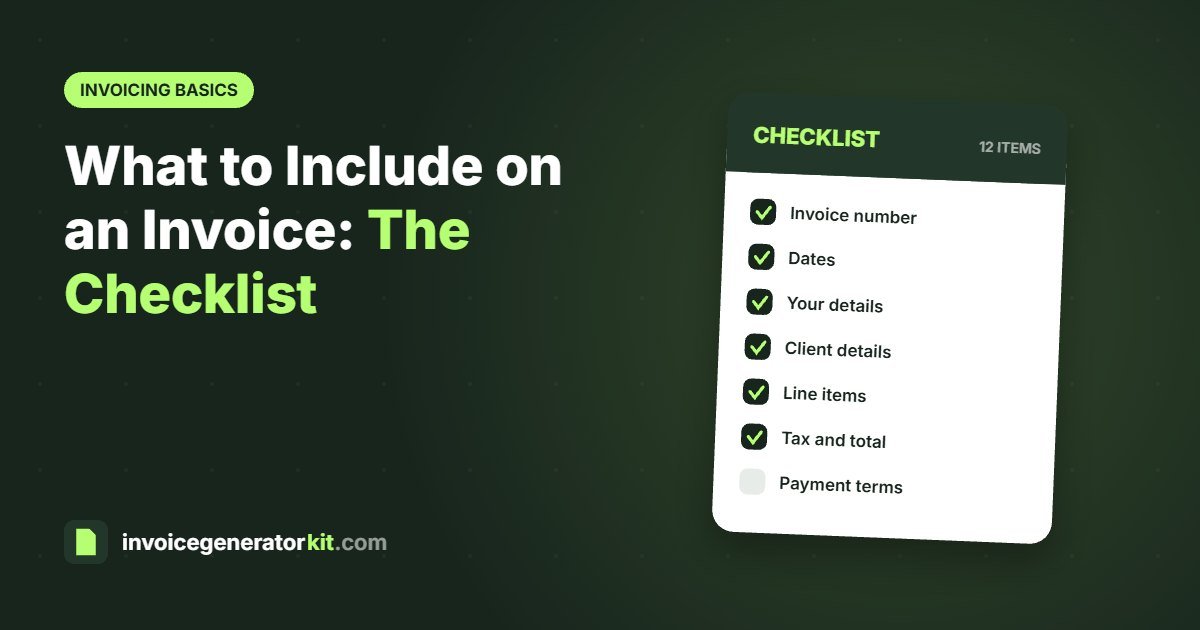
An invoice should include a unique invoice number, the invoice date, your business name and contact details, your client's name and address, a description of what you supplied, the date of supply, the amount for each item, any tax, and the total amount due. Adding payment terms and payment details is what turns a valid invoice into one that gets paid on time.
Below is the full checklist, what each item is for, and the extra details needed for VAT invoices, sole traders and limited companies.
The quick checklist
- The word "Invoice" at the top
- A unique, sequential invoice number
- The invoice date
- The date you supplied the goods or services
- Your business name, address and contact details
- Your client's name and billing address
- A clear description of each item or service
- Quantity, rate and amount for each line
- Subtotal, any discount and any tax
- The total amount due
- The due date and payment terms
- How to pay you
The details every invoice must include
A unique invoice number
The invoice number identifies the document in your records and your client's. Use a simple sequence such as INV-001, INV-002, or add the year, such as INV-2026-001. Do not skip or reuse numbers.
Invoice date and supply date
The invoice date is when you issue the invoice. The supply date is when you delivered the goods or finished the service. They are often the same, but if they are not, show both.
Your details and your client's details
Include your business name, address, email and phone number, and the name and address of the customer you are billing. If the client gave you a purchase order number, add it so their accounts team can match the invoice quickly.
A clear description of what you are charging for
Each line should say exactly what was supplied. "Bathroom tiling, 12 square metres, materials included" is far better than "Building work". Clear lines mean fewer questions and faster approval.
Amounts, tax and the total
Show the quantity, rate and amount for each line, then the subtotal, any discount, the tax and the final total. If the client has paid a deposit, show the amount paid and the balance due.
Details that help you get paid faster
- A due date. Write the actual date, not just "30 days".
- Payment terms. For example "Due on receipt" or "Net 14". Mention any late payment fee you are allowed to charge.
- Payment details. Bank name, account number, sort code or IBAN, or your PayPal or Wise email.
- Your logo and brand colour. A professional invoice is easier to find and harder to ignore.
- A short thank you note. Small touches keep the relationship friendly.
Extra details for VAT, GST and sales tax invoices
If you are registered for a sales tax, your invoice usually needs more information. In the UK, you must issue a VAT invoice when both you and your customer are VAT registered. A full VAT invoice normally also shows:
- Your VAT registration number
- The VAT rate charged on each item
- The total amount excluding VAT
- The total amount of VAT
- The total including VAT
Rules differ by country, and in the US by state, so check with your tax authority or accountant if you are unsure. You can set the document title to "Tax Invoice" and add your tax number in InvoiceGeneratorKit.
Sole traders and limited companies
According to GOV.UK, sole traders must show their own name and any business name they trade under. If they use a business name, they must also give an address where legal documents can be delivered.
Limited companies must use the full company name exactly as it appears on the certificate of incorporation. Directors' names are optional, but if you include one you must include them all.
Invoice, receipt or quote: which one do you need?
| Document | When you send it | What it says |
|---|---|---|
| Quote or estimate | Before the work starts | What the job will cost |
| Proforma invoice | Before delivery, often for a deposit | What will be invoiced |
| Invoice | After the work is done | What the client owes and when |
| Receipt | After payment | That the money has been received |
Check your invoice before you send it
Before you hit send, check that the invoice number is new, the client's name is spelled correctly, the totals add up and your payment details are right. Then send it as a PDF.
The free invoice generator includes every field on this checklist and does the maths for you. For a walkthrough, read how to generate an invoice.
Frequently asked questions
What are the legal requirements for an invoice?
In the UK an invoice must include a unique number, your business name and contact details, the customer's name and address, a description of what you supplied, the supply date, the invoice date, the amounts charged, any VAT, and the total owed. Other countries have similar rules, so check with your local tax authority.
Does an invoice need a due date?
It is not always a legal requirement, but you should always include one. A clear due date is one of the simplest ways to get paid on time.
Do I need a logo on my invoice?
No, a logo is optional. It does make the invoice look more professional and easier for the client to recognise.
Can I include a late payment fee on an invoice?
You can state a late payment fee in your terms if your contract or local law allows it. In the UK, businesses can usually claim statutory interest and compensation on late commercial payments.
Create your invoice now
Add your logo, line items and tax, see it on a real A4 page, then download a clean PDF. Free, with no sign up.