What Is an Invoice? Meaning, Example and How It Works
An invoice is a document a seller sends to a buyer asking for payment for goods or services. Here is what that means in practice, with an example and the main types explained.
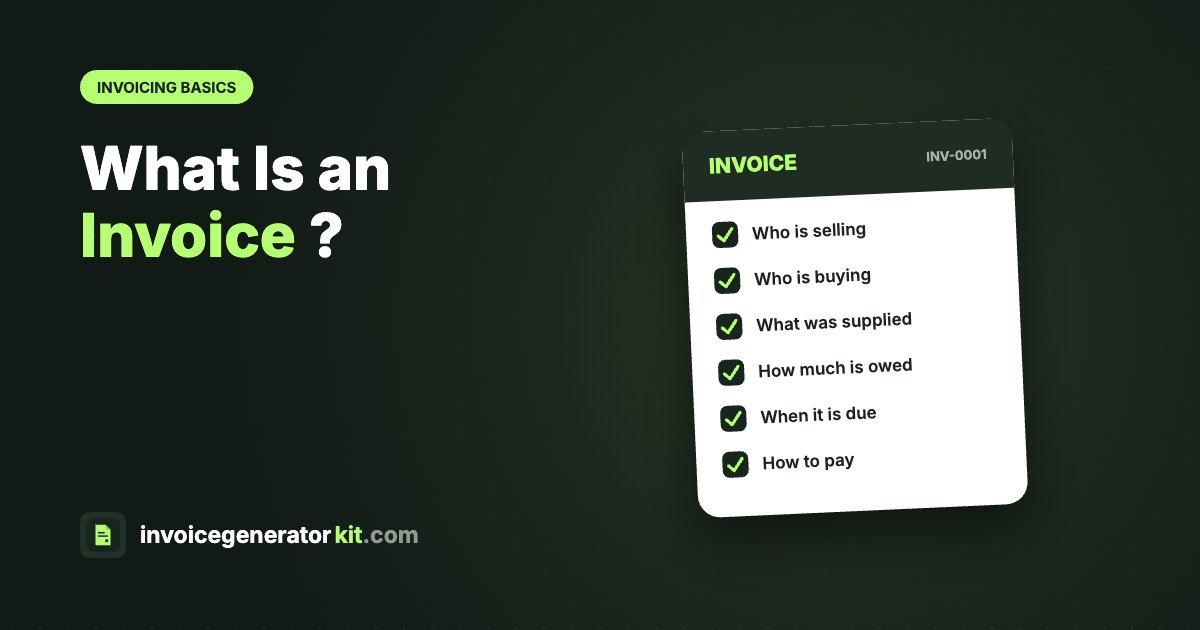
An invoice is a document a seller sends to a buyer to request payment for goods or services that have been supplied. It shows who is selling, who is buying, what was supplied, how much it costs, any tax, the total owed and when payment is due. For the seller it is a record of income; for the buyer it is a record of a purchase and a cost.
What is an invoice used for?
- Getting paid. It tells the customer exactly how much to pay, by when and how.
- Record keeping. Businesses use invoices to track sales and income for accounts and tax returns.
- Tax. VAT-registered businesses use VAT invoices to charge and reclaim VAT.
- Legal evidence. If a customer does not pay, the invoice helps prove what was owed and when.
What does an invoice look like?
Most invoices follow the same layout: your business details and logo at the top, the word "Invoice" with a number and date, the customer's details, a table of items, the totals and the payment details at the bottom. A simple example:
| Description | Qty | Rate | Amount |
|---|---|---|---|
| Website design, 5 pages | 1 | £1,200.00 | £1,200.00 |
| Hosting setup | 1 | £80.00 | £80.00 |
| Total due by 14 Nov 2026 | £1,280.00 |
For a full annotated layout, see our invoice example, or make your own with the free invoice generator.
What information goes on an invoice?
In the UK an invoice should include a unique invoice number, your business name and address, your customer's name and address, a clear description of what you supplied, the supply date, the invoice date, the amounts charged, any VAT and the total owed. The full list, with the extra rules for VAT and limited companies, is in our invoice checklist.
Invoice vs bill vs receipt vs quote
| Document | When it is sent | What it means |
|---|---|---|
| Quote | Before the work | A fixed price offer the customer can accept |
| Invoice | After the work or delivery | A request for payment |
| Bill | After the work or delivery | Usually the same as an invoice, from the buyer's side |
| Receipt | After payment | Proof that payment was made |
More detail: invoice vs receipt and quote vs estimate vs invoice.
Types of invoice
- Standard invoice: the everyday request for payment after a job.
- Proforma invoice: a preliminary invoice sent before work or delivery. See what is a proforma invoice.
- VAT invoice: issued by VAT-registered businesses and must meet HMRC rules. See VAT invoice requirements.
- Interim or progress invoice: bills part of a larger project at agreed stages.
- Recurring invoice: the same amount on a regular schedule, such as a monthly retainer.
- Timesheet invoice: bills for hours worked. See how to invoice for hours worked.
- Credit note: reduces or cancels an invoice already sent. See credit note vs invoice.
How does invoicing work?
- You agree a price and terms with your customer.
- You supply the goods or finish the work.
- You send an invoice with a due date. Here is how to send an invoice.
- The customer pays by the due date. If they do not, see how to chase an unpaid invoice.
- You mark the invoice as paid and keep it for your records.
Need to send one now? Create a free invoice in your browser and download a professional PDF in two minutes.
Frequently asked questions
What is the simple meaning of invoice?
An invoice is a request for payment. It lists what a business sold, how much it costs and when the customer needs to pay.
Is an invoice a bill?
Yes, essentially. "Invoice" is the seller’s word for the document and "bill" is often the buyer’s word for the same thing. In everyday use the two mean the same.
Is an invoice proof of payment?
No. An invoice shows money is owed. Proof of payment is a receipt, an invoice marked as paid, or a bank record of the transfer.
Who issues an invoice?
The seller, whether that is a freelancer, sole trader, limited company or larger business. The buyer receives it and pays it.
Is an invoice legally binding?
An invoice is evidence of a debt under the agreement you made with your customer. The contract itself, written or verbal, creates the obligation to pay; the invoice records the amount and terms.
Create your invoice now
Add your logo, line items and tax, see it on a real A4 page, then download a clean PDF. Free, with no sign up.