Credit Note vs Invoice: What Is a Credit Note and When to Issue One
Sent an invoice with a mistake, or agreed a refund? You do not delete the invoice; you issue a credit note. Here is how it works, with an example.
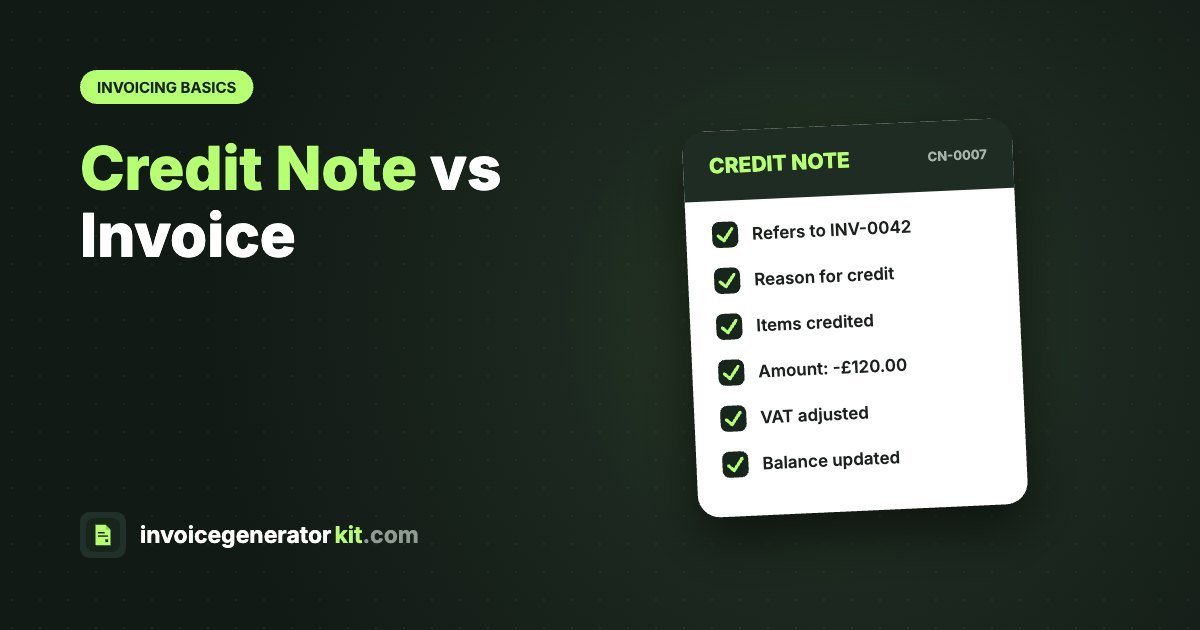
An invoice asks a customer to pay; a credit note reduces or cancels what they owe on an invoice you have already sent. You issue a credit note when an invoice was wrong, goods were returned, work was cancelled or you agreed a discount after invoicing. The original invoice stays in your records, and the credit note sits alongside it so your accounts and any VAT stay accurate.
Credit note vs invoice at a glance
| Invoice | Credit note | |
|---|---|---|
| Purpose | Requests payment | Reduces or cancels an amount owed |
| Effect on balance | Increases what the customer owes | Decreases what the customer owes |
| Numbering | INV-0001, INV-0002… | Separate sequence, e.g. CN-0001 |
| References | Order or quote | The original invoice number |
| Effect on VAT | Charges VAT | Reduces the VAT charged |
When to issue a credit note
- Billing mistakes: wrong price, quantity or client details.
- Returns: the customer sent goods back.
- Cancelled work: part of a job did not go ahead.
- Agreed discounts: a goodwill reduction after invoicing.
- Duplicate invoices: the same work was billed twice.
What a credit note should include
- The words "Credit note" at the top
- A unique credit note number
- The date of issue
- Your business details and the customer's details
- The original invoice number and date
- The reason for the credit
- The items and amounts being credited
- If VAT registered, the VAT rate and VAT being credited. See VAT invoice requirements
Credit note example
Invoice INV-0042 charged a client for 10 hours of design at £60, but only 8 hours were worked.
| Credit note CN-0007 | Qty | Rate | Amount |
|---|---|---|---|
| Credit for 2 hours design billed in error on INV-0042 | 2 | £60.00 | £120.00 |
| Total credited | £120.00 | ||
The client now owes £480 instead of £600. If they had already paid the full £600, you would either refund £120 or let them use the credit against their next invoice.
Full credit and re-invoice vs partial credit
For small corrections, a partial credit note is cleanest. If an invoice is wrong in several places, credit it in full and issue a fresh invoice with a new number. Never reuse the old invoice number. Our guide to numbering invoices explains why.
Credit note vs debit note vs refund
- Credit note: issued by the seller to reduce what is owed.
- Debit note: usually issued by a buyer to request a credit, or by a seller to increase an amount already invoiced.
- Refund: the actual return of money after a credit note when the invoice was already paid.
Need to reissue a corrected invoice? Create one in seconds with our free invoice generator.
Frequently asked questions
What is a credit note?
A credit note is a document a seller issues to reduce or cancel the amount owed on an invoice already sent, for example because of an error, a return or an agreed discount.
Can I just delete or edit an invoice instead?
No. Once an invoice has been sent it should stay in your records. Issue a credit note to reverse all or part of it, and a new invoice if the amount needs correcting.
Does a credit note need its own number?
Yes. Give credit notes their own sequence, such as CN-0001, and always reference the original invoice number.
Is a credit note the same as a refund?
Not exactly. A credit note reduces what the customer owes. If they have already paid, you can either refund the money or let them use the credit against a future invoice.
What must a VAT credit note show?
It should show the same basic details as a VAT invoice, the original invoice number and date, the reason for the credit, the amount credited excluding VAT, the VAT rate and the VAT being credited.

Create your invoice now
Add your logo, line items and tax, see it on a real A4 page, then download a clean PDF. Free, with no sign up.