How to Write a Receipt: Step by Step Guide with Examples
Learn how to write a receipt that includes everything it should, with step by step instructions and UK and US receipt examples you can copy.
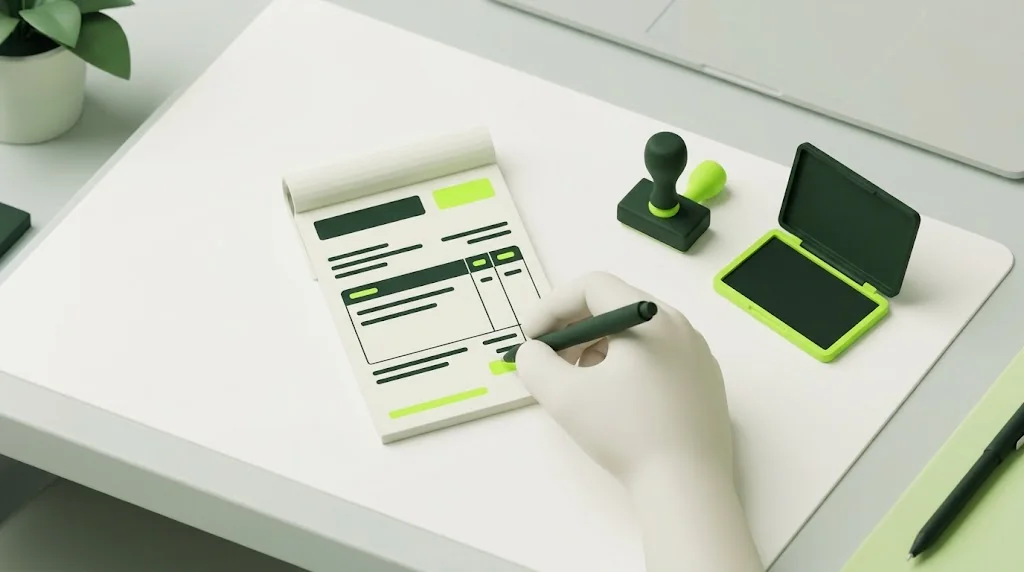
To write a receipt, include your business name and contact details, a receipt number, the date, the customer's name, a description of what was bought, the amount paid, the payment method and any tax. Then add a total and a short note such as "Paid in full". A clear receipt takes a couple of minutes and gives both you and your customer proof of payment.
This guide walks you through each step, shows a receipt example you can copy, and covers the extra details you may need for tax, partial payments and cash.
What is a receipt?
A receipt is a written confirmation that payment has been received. It is different from an invoice, which asks for payment. You send an invoice before you are paid, and a receipt after. If you want the full comparison, read our guide to invoice vs receipt.
Customers use receipts to track spending, claim expenses, return goods and prove they paid. You use them to keep accurate records of your income and to answer any questions later.
What to include on a receipt
| Detail | Why it matters |
|---|---|
| Your business name, address and contact details | Shows who received the money |
| Receipt number | Makes every receipt unique and easy to find |
| Date of payment | Records when the money was received |
| Customer name | Shows who paid, useful for business customers claiming expenses |
| Description of goods or services | Shows what the payment was for |
| Quantity and price of each item | Lets the customer check the total |
| Subtotal, tax and total | Shows exactly what was paid and any tax included |
| Payment method | Cash, card, bank transfer, check or PayPal |
| Balance remaining | Needed if the payment was only part of the total |
| Invoice number, if any | Links the receipt to the invoice it settles |
Not every receipt needs every line. A quick cash sale might only need the date, item, amount and your business name. But the more detail you include, the more useful the receipt is for both sides.
How to write a receipt, step by step
- Add a clear title. Write "Receipt" at the top so it cannot be mistaken for an invoice or quote.
- Add your business details. Your name or business name, address, phone or email. Add a logo if you have one.
- Give it a receipt number. Use a simple sequence such as R0001, R0002. Never reuse a number. The same idea applies to numbering invoices.
- Write the date the payment was received.
- Add the customer's name. For business customers, include their company name and address too.
- Describe what was paid for. List each item or service with quantity and price.
- Show the subtotal, any discount, tax and the total.
- Write the payment method. Add a transaction reference or check number if there is one.
- Show the balance. Write "Paid in full" or the amount still owed.
- Add a short thank you and, if relevant, your returns or refund policy.
- Send or hand it over, and keep a copy.
Receipt example
Here is a simple receipt you can copy and adapt for your own business:
RECEIPT
Receipt number: R0087
Date: 22 April 2026
From: Greenleaf Garden Services, 7 Oak Road, Manchester M20 2RN, hello@greenleafgardens.co.uk
Received from: Mrs Helen Carter, 14 Birch Avenue, Manchester
Lawn mowing and edging, 1 visit: £45.00
Hedge trimming, front garden: £60.00
Green waste removal: £20.00
Subtotal: £125.00
Total paid: £125.00
Payment method: Bank transfer, ref GARDEN0422
Invoice: INV0412
Status: Paid in full
Thank you for your business.
And a US example with sales tax:
RECEIPT
Receipt number: 1043
Date: 3 August 2026
From: Clearview Computer Repair, 210 Main Street, Austin, TX
Received from: Daniel Ruiz
Laptop screen replacement (part): $140.00
Labor, 1 hour: $75.00
Sales tax on part: $11.55
Total paid: $226.55
Payment method: Card, ending 4421
Status: Paid in full
Sales tax rules differ by state, including whether labor is taxable, so check the rules where you work.
Receipts and tax
If you are registered for sales tax or VAT, your receipts may need to show extra information.
In the UK, VAT registered businesses must give a VAT invoice to VAT registered customers. For retail sales of £250 or less including VAT, a simplified VAT invoice is allowed, showing fewer details. A simple till receipt does not always meet the rules, so check our guide to VAT invoice requirements in the UK or ask your accountant.
In the US, sales tax is set at state and local level, and requirements for what a receipt must show vary. If you collect sales tax, show it as a separate line so the customer can see it.
If you are not registered for VAT or sales tax, do not add tax to your receipts.
Partial payments and deposits
When a customer pays only part of the total, such as a deposit, the receipt must make that clear. Show the total price, the amount paid now and the balance remaining.
Received £300.00 deposit toward kitchen fitting, total price £1,800.00. Balance remaining: £1,500.00, due on completion.
When the final payment arrives, issue another receipt for that amount and mark the job as paid in full.
Cash receipts
Receipts matter most when a customer pays in cash, because there is no bank record. Always give a receipt for cash, keep a copy yourself, and write "Cash" as the payment method. Our guide to the cash receipt covers this in more detail. If you are a landlord collecting rent, see our rent receipt guide.
Handwritten vs digital receipts
A handwritten receipt from a carbon copy receipt book is still valid, as long as it shows the key details and is easy to read. It can be handy on site or at a market stall.
Digital receipts are easier to keep organised. You can email or message a PDF the moment payment arrives, and find it again in seconds. They also look more professional, which matters if your customer is a business that will file it with their expenses.
The free InvoiceGeneratorKit generator lets you change the document title to Receipt, add your logo, list items with tax or discounts, and mark the document as paid so a PAID stamp appears. You can download it as a PDF with no sign up. Saved clients and quick items make repeat receipts faster.
Tips for writing better receipts
- Be specific: "Bathroom tap replacement" is better than "Plumbing work".
- Use consistent numbering so you can find any receipt quickly.
- Issue it promptly, ideally the same day payment is received.
- Match the invoice: if you sent an invoice, quote its number on the receipt.
- Keep copies for as long as your tax authority requires. In the UK and US this is usually several years, so check current guidance.
- Check the maths before you send. A wrong total undermines the whole point of a receipt.
Write receipts the same way every time, and your records will almost look after themselves.
Frequently asked questions
What must be included on a receipt?
At minimum, your business name, the date, what was bought, the amount paid and the payment method. A receipt number, customer name and tax details make it more useful.
Is a handwritten receipt valid?
Yes, as long as it is legible and shows the key details. Keep a copy for your own records.
What is the difference between a receipt and an invoice?
An invoice asks for payment and is sent before you are paid. A receipt confirms payment and is given after the money is received.
How do I write a receipt for a partial payment?
Show the total price, the amount paid now and the balance remaining. Issue a new receipt when the rest is paid.
Do I need to show VAT or sales tax on a receipt?
Only if you are registered and charged it. Rules differ in the UK and between US states, so check local requirements or ask an accountant.
Create your invoice now
Add your logo, line items and tax, see it on a real A4 page, then download a clean PDF. Free, with no sign up.