What Is a PO Number? Purchase Order Numbers Explained
A PO number is the buyer's reference for an approved order. Learn how PO numbers work, how they differ from invoice numbers and where to put one on an invoice.
A PO number (purchase order number) is a unique reference a buyer gives to an order before it is fulfilled. The buyer creates a purchase order listing what they want to buy, and the PO number identifies that order. When you invoice, you quote the PO number so the buyer's accounts team can match your invoice to the approved order and pay it.
If a client has given you a PO number, putting it on your invoice is one of the simplest ways to get paid faster. Leave it off, and your invoice may sit in a queue while someone works out what it is for.
What is a purchase order?
A purchase order is a document the buyer sends to the seller to confirm what they are ordering. It usually lists the items or services, quantities, agreed prices, delivery details and payment terms. Once the seller accepts it, the purchase order works as an agreement between the two businesses.
The PO number is simply the reference for that document. It might look like PO4521, PO2026 0193 or 45001234, depending on the buyer's system. You do not choose it. The buyer does.
For a full comparison of the two documents, read our guide to purchase orders vs invoices.
Why businesses use PO numbers
Purchase orders help buyers control spending. Before anything is ordered, someone with authority approves the PO. That gives the business:
- Budget control: only approved purchases go ahead.
- A clear record: every purchase can be traced back to who approved it.
- Easy matching: the accounts team can match the PO, the delivery and the invoice.
- Fewer disputes: prices and quantities are agreed in writing before work starts.
Larger companies, schools, councils, hospitals and government bodies very often require a PO for every purchase. Some will not pay an invoice at all unless it shows a valid PO number.
How the PO process works
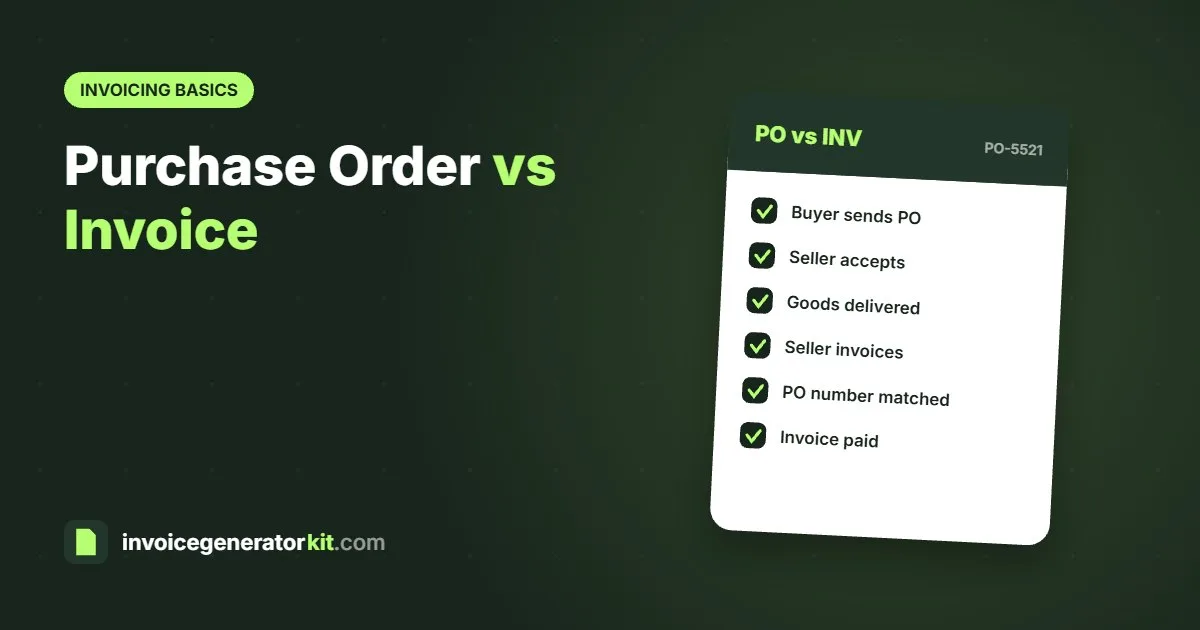
Here is the usual flow from order to payment:
- The buyer raises a purchase order and gets it approved internally.
- The buyer sends the PO to you with its PO number.
- You check and accept the PO. Make sure the items, prices and terms match what you agreed.
- You deliver the goods or complete the work.
- You send an invoice that quotes the PO number.
- The buyer matches the invoice to the PO and to proof of delivery. This is often called a three way match.
- The buyer pays according to the agreed payment terms.
The three way match is the step where invoices most often get stuck. If the PO number is missing, wrong, or the invoice amount does not match the PO, the invoice is usually sent back or put on hold.
PO number vs invoice number
People mix these up all the time, but they come from different sides of the deal.
| PO number | Invoice number | |
|---|---|---|
| Who creates it | The buyer | The seller |
| When | Before the order is fulfilled | After the goods or work are delivered |
| What it identifies | An approved order | A request for payment |
| Is it required on an invoice? | Only if the buyer uses POs | Yes, always |
| Can one cover several of the other? | Yes, one PO can be billed over several invoices | An invoice usually references one PO |
Your invoice number is your own reference, and it should follow your own sequence. See how to number invoices for a simple system. The PO number is the buyer's reference, and you copy it exactly as they gave it.
Where to put the PO number on an invoice
Put the PO number near the top of the invoice, close to your invoice number and date, where the client's accounts team will look first. Label it clearly as "PO number" or "Purchase order".
Here is an example of the top section of an invoice with a PO number:
INVOICE
Invoice number: INV0158
Invoice date: 9 June 2026
PO number: PO77412
Due date: 9 July 2026
Bill to: Brightwell Facilities Ltd, Accounts Payable, 22 Station Road, Reading
Office deep clean, 3 floors, as per PO77412: £1,350.00
VAT at 20%: £270.00
Total due: £1,620.00
Many buyers also ask you to put the PO number in the email subject line when you send the invoice. For example:
Subject: Invoice INV0158 for PO77412, Brightwell Facilities
Hello, please find attached invoice INV0158 for the office deep clean completed on 5 June 2026, referencing purchase order PO77412. The total is £1,620.00, due by 9 July 2026. Please let me know if you need anything else to process it. Kind regards, Sam
Whatever tool you use, check that the PO number appears clearly before you send. The free InvoiceGeneratorKit invoice generator creates your invoice numbers automatically and shows a true A4 preview, so you can check every reference on the page before you download the PDF.
If one PO covers a long project billed in stages, quote the same PO number on every invoice and add a short line such as "Stage 2 of 3" so the client can track how much of the order has been billed.
What if the client has not given you a PO number?
If you work with a larger company and they have not sent a PO, ask before you start the work. A short message is enough:
Before I start, could you send over the purchase order number for this job? I will quote it on the invoice so it reaches the right team without delay.
If the client says they do not use purchase orders, that is fine. Many small businesses and individuals never use them. In that case you can leave the PO field off your invoice entirely. Do not make up a PO number, as it will only confuse their records.
Common PO number mistakes that delay payment
- Leaving it off: the most common reason for a PO invoice being rejected.
- Typing it wrong: one missing digit means no match. Copy and paste it where you can.
- Billing more than the PO value: if the job grew, ask the client to raise or amend the PO before you invoice the extra.
- Using an expired PO: some POs are only valid for a set period or a set amount.
- Sending to the wrong address: many POs say exactly where invoices must be sent, often a dedicated accounts email.
If an invoice is late and you suspect a PO issue, check these points first before you chase. Our guide on how to chase an unpaid invoice covers the next steps.
Do you need to issue your own purchase orders?
If you are a freelancer or small business, you usually receive POs rather than send them. But if you buy regularly from suppliers, a simple PO system can help you too. Give each order a number, write down what you agreed, and check supplier invoices against it before you pay. It is an easy way to catch overcharges.
The key thing to remember is simple: when a client gives you a PO number, put it on the invoice, exactly as written, every time.
Frequently asked questions
What does PO number mean?
PO stands for purchase order. A PO number is the unique reference a buyer gives to an approved order, and sellers quote it on their invoice.
Who provides the PO number?
The buyer always provides it. As the seller, you copy it onto your invoice exactly as written.
Is a PO number the same as an invoice number?
No. The buyer creates the PO number before the order, and the seller creates the invoice number when asking for payment.
Do I need a PO number on every invoice?
Only if your client uses purchase orders. Many small businesses do not, so you can leave it off unless the client asks for it.
What happens if I forget the PO number?
Larger clients often reject or hold invoices without a valid PO number, which delays payment. Resend the invoice with the correct number added.
Create your invoice now
Add your logo, line items and tax, see it on a real A4 page, then download a clean PDF. Free, with no sign up.