Self-Employed Invoice Template (UK): What to Include and a Free Generator
Everything a UK sole trader or freelancer needs on an invoice, a worked example you can copy, and a free generator that turns it into a PDF in two minutes.
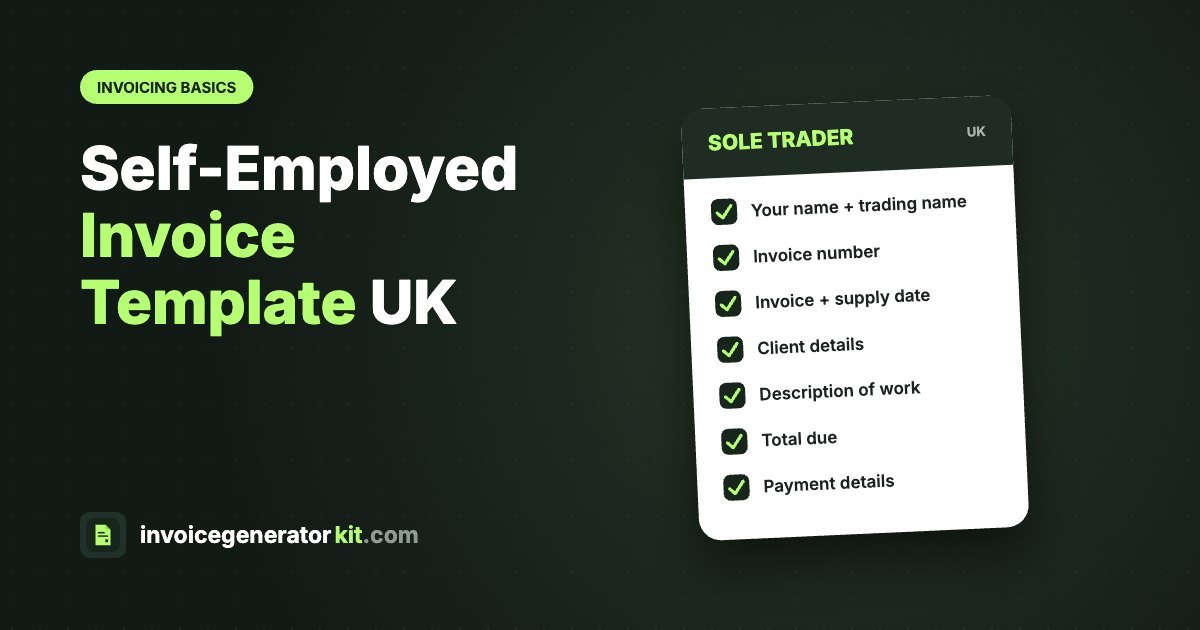
A self-employed invoice in the UK needs your name (and trading name if you use one), your address, the word "Invoice", a unique invoice number, the invoice date, the date of the work, your client's name and address, a description of what you did, the amount owed and how to pay. If you are not VAT registered, that is all you need. Add a due date and your bank details and most clients will pay without chasing.
Below is the full checklist, a worked example you can copy, and the quickest way to turn it into a professional PDF with our free invoice generator.
What a self-employed invoice must include
| Detail | Required? | Why it matters |
|---|---|---|
| Your full name and any trading name | Yes | Shows who is legally owed the money |
| Your business address | Yes | Needed if you use a trading name, and expected by most clients |
| Client name and address | Yes | Identifies who must pay |
| The word "Invoice" | Yes | Separates it from a quote or receipt |
| Unique invoice number | Yes | HMRC expects a clear, sequential record |
| Invoice date and supply date | Yes | Sets the tax point and starts the payment clock |
| Description, quantity and price | Yes | Avoids disputes about what was supplied |
| Total amount due | Yes | The figure the client pays |
| Due date and payment terms | Strongly advised | Without terms, the legal default is 30 days |
| Bank details or payment link | Strongly advised | Removes the main excuse for paying late |
| VAT number and VAT breakdown | Only if VAT registered | Required for VAT invoices |
For a deeper breakdown of each field, see our complete invoice checklist.
A self-employed invoice example
Here is how a simple sole trader invoice looks when it is laid out properly:
- From: Sam Patel trading as Patel Decorating, 12 High Street, Northampton NN1 1AA, sam@pateldecorating.co.uk
- Bill to: Jane Smith, 4 Park Road, Kettering NN15 6BB
- Invoice number: INV-0042
- Invoice date: 3 November 2026. Work completed: 31 October 2026
- Due date: 17 November 2026 (14 days)
| Description | Qty | Rate | Amount |
|---|---|---|---|
| Paint living room, two coats, walls and ceiling | 1 | £480.00 | £480.00 |
| Materials (paint, filler, sundries) | 1 | £95.00 | £95.00 |
| Total due | £575.00 |
Payment by bank transfer to Patel Decorating, sort code 00-00-00, account 12345678, reference INV-0042. No VAT is shown because the business is not VAT registered.
How to create your invoice in two minutes
- Open the InvoiceGeneratorKit invoice generator. There is nothing to sign up for.
- Add your name, trading name, address and logo. Tick "remember my details" so they are filled in next time.
- Enter your client's details and the invoice and due dates.
- Add a line for each job or item, with quantity and rate. The totals calculate automatically.
- Add your bank details in the payment section, then preview and download the PDF.
Your next invoice number is suggested for you. If you are setting up a system for the first time, our guide to numbering invoices explains the simplest formats.
Sole trader vs limited company invoices
A sole trader invoice is in your own name. If you trade through a limited company, the invoice must instead show the company's full registered name, company number, place of registration (for example "Registered in England and Wales") and registered office address. Mixing the two up is one of the most common mistakes new freelancers make when they incorporate.
Tips to get paid faster as a freelancer
- Invoice the same day the work finishes. The longer you wait, the later you get paid.
- Use short terms. 7 or 14 days is normal for individuals and small jobs. Our guide to invoice payment terms explains the options.
- Name the invoice in the email subject. "Invoice INV-0042 from Patel Decorating, due 17 Nov" is easy to find and hard to ignore.
- Ask for a deposit on bigger jobs. A proforma invoice works well for this.
- Mark invoices paid. Keep a clear record so your Self Assessment figures match your bank.
Do you need to register for VAT?
Most self-employed people do not charge VAT. You only need to register once your VAT-taxable turnover passes £90,000 in any rolling 12-month period, although you can register voluntarily below that. Once registered, your invoices must follow HMRC's VAT invoice rules, including your VAT number and the VAT amount for each rate. See GOV.UK's invoicing guidance for the official list.
Frequently asked questions
Do self-employed people need to send invoices?
There is no law that says a sole trader must send an invoice unless they are VAT registered and selling to another VAT-registered business. In practice you should invoice every job, because the invoice is your record of income for HMRC and the clearest way to get paid on time.
Can I invoice without a business name?
Yes. If you trade under your own name, put your full name at the top. If you use a trading name, show both, for example "Sam Patel trading as Patel Plumbing", along with an address where documents can be served.
Do I need a UTR number on my invoice?
No. Your Unique Taxpayer Reference is for HMRC and does not need to appear on invoices. Some clients ask for it, especially in construction under CIS, but it is not a legal requirement.
Do I charge VAT as a sole trader?
Only if you are VAT registered. You must register once your VAT-taxable turnover goes over £90,000 in a rolling 12 months. If you are not registered, do not add VAT and do not show a VAT number.
How long should I keep copies of my invoices?
Sole traders should keep business records, including invoices, for at least 5 years after the 31 January Self Assessment deadline for the tax year they relate to.
Create your invoice now
Add your logo, line items and tax, see it on a real A4 page, then download a clean PDF. Free, with no sign up.