Invoice Terms and Conditions: Examples You Can Copy
The terms and conditions on an invoice set the rules for payment. Here is what to include, with short examples you can copy for payment, late fees, deposits and disputes.
Invoice terms and conditions are the short rules at the bottom of an invoice that explain when and how the client must pay and what happens if they do not. Clear terms reduce late payments and give you something to point to if there is a dispute. They should match whatever you agreed with the client before the work started.
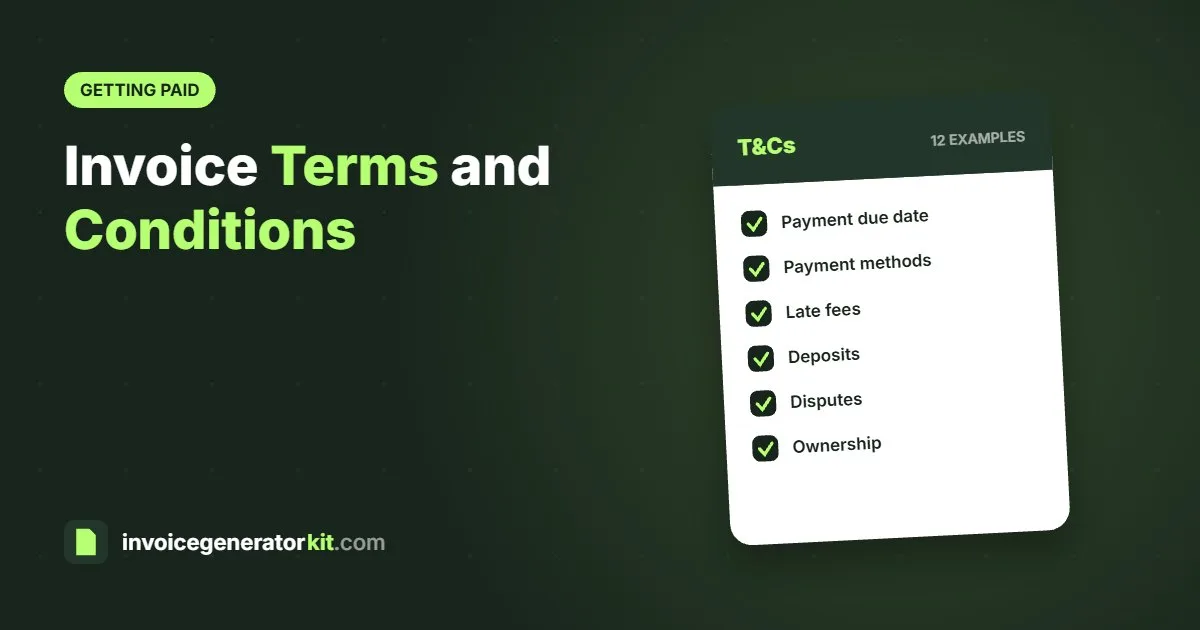
What to include in invoice terms and conditions
- Payment due date: the exact date, or a term such as Net 14
- Payment methods: bank transfer, card, PayPal or others you accept
- Late payment: any interest or fee charged on overdue amounts
- Deposits and stages: what was paid upfront and when the rest is due
- Disputes: how long the client has to raise a problem with the invoice
- Ownership: when rights to the work or goods pass to the client
Keep the list short. Three to five lines that a client will actually read work better than a page of small print.
Invoice terms and conditions examples
Copy and adapt any of these lines. Replace the numbers with what you agreed.
Payment terms
- Payment is due within 14 days of the invoice date.
- Payment is due on receipt of this invoice.
- Please pay by bank transfer using the invoice number as the reference.
- We accept bank transfer and card. Card payments may carry a 3% fee.
Late payment
- Overdue invoices are charged interest at 1.5% per month on the outstanding balance.
- A late fee of $25 applies to payments received after the due date.
- We reserve the right to pause work on accounts more than 14 days overdue.
Late fees only work if the client agreed to them in advance, so put them in your quote or contract too. In the UK, businesses can claim statutory interest and compensation on late commercial payments even if no rate was agreed. See late payment interest in the UK.
Deposits and staged payments
- A non refundable deposit of 25% is required before work begins.
- The remaining balance is due on completion of the work.
Disputes and ownership
- Please raise any questions about this invoice within 7 days of receipt.
- Ownership of all deliverables passes to the client once this invoice is paid in full.
- Goods remain our property until payment has been received in full.
Sample terms and conditions block
Here is a complete example that fits in the Terms box of most invoices:
Payment is due within 14 days of the invoice date by bank transfer, quoting the invoice number. Overdue balances may be charged interest at 1.5% per month. Please raise any queries within 7 days. Ownership of the work passes to the client on payment in full. Thank you for your business.
Payment terms vs terms and conditions
Payment terms are one part of your terms and conditions: the when and how of payment, such as Net 30. Terms and conditions are wider and can cover late fees, disputes and ownership. Our guide to invoice payment terms explains Net 30, Due on receipt and the other common options.
Are invoice terms and conditions legally binding?
An invoice on its own usually cannot add new terms the client never agreed to. Terms are strongest when they are part of the agreement before the work starts, through a quote, contract or signed proposal, and then repeated on the invoice. This is general information, not legal advice, so check the rules where you work.
How to add terms and conditions to your invoice
- Open the free invoice generator.
- Pick your payment terms in the invoice details so the due date fills in.
- Paste your terms into the Terms box in the Notes and payment section.
- Tick Remember my details and your terms are filled in on every new invoice.
Tips for terms that get you paid
- Use plain words. If a client has to read a line twice, rewrite it
- Write the due date as a date, not only as Net 30
- Keep the tone polite: terms are a reminder, not a threat
- Be consistent and actually apply late fees when you say you will
Frequently asked questions
What should I write in terms and conditions on an invoice?
Include the payment due date, accepted payment methods, any late fee or interest, deposit or stage payment rules, how to raise disputes and when ownership passes to the client.
Can I charge a late fee if it is in my invoice terms?
It is safest when the late fee was agreed before the work, in a quote or contract, and then repeated on the invoice. In the UK, statutory late payment interest applies to business to business invoices.
What is the difference between payment terms and terms and conditions?
Payment terms say when and how to pay, such as Net 14. Terms and conditions cover payment terms plus other rules like late fees, disputes and ownership.
How long should invoice terms and conditions be?
Short. Three to five clear lines are enough for most invoices. Put longer legal terms in your contract and refer to it on the invoice.
Create your invoice now
Add your logo, line items and tax, see it on a real A4 page, then download a clean PDF. Free, with no sign up.